Fort Wagner / 54th Massachusetts
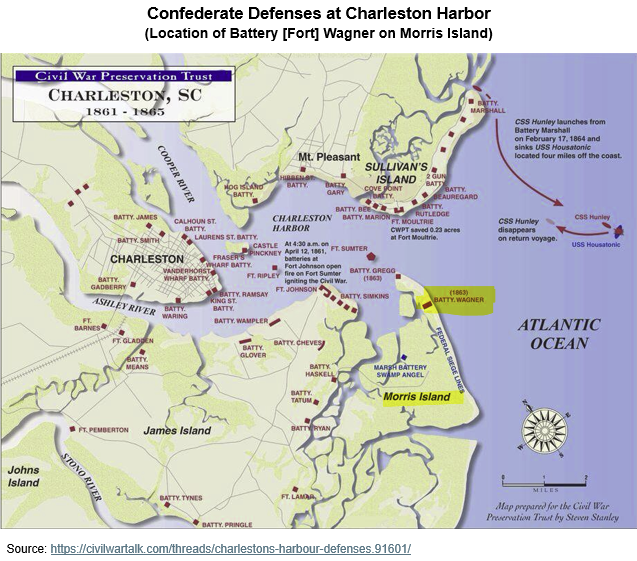
The Battle of Fort Wagner consisted of land assaults on July 11, 1863 and July 18 followed by a siege lasting from July 19 - September 7, 1863. Fort Wagner was a sand, earthen, and palmetto log stronghold on the northern end of Morris Island. (Refer to above map for fort's location within Charleston Harbor.) Fort Wagner bristled with 14 heavy guns, mortars, carronades (a), and field pieces situated among a well-laid-out fortress, designed to withstand modern rifled artillery fire. (Note: Rifled artillery could fire shells further and more accurately than the previously used smooth-bore cannon. In April 1862, Fort Pulaski, located on Cockspur Island Savanna, GA, was partially destroyed by rifled artillery firing large canister shells .)...
(a) carronade = A short, lightweight, cast-iron naval cannon used primarily by the British Royal Navy during the late 18th and early 19th centuries.
...Brig. Gen. Quincy Gillmore was assigned to lead the 1863 campaign against the city of Charleston…. Gillmore’s plan, supported by a heavy naval presence, was to seize Morris Island so he could place heavy rifled guns on Cummings Point that would, in turn, neutralize Fort Sumter. Once Sumter was reduced, the army and the navy could move swiftly to capture Charleston, the birthplace of the [Confederate] rebellion....
The July 11 assault was easily repulsed by Fort Wagner's 1,620 Confederate soldiers.
...After the initial assault, the Federals prepared for prepared for a new and better-coordinated attack upon Fort Wagner. The new plan included a close-range land and sea bombardment of the fort, followed by a land assault of some 5,000 soldiers. The larger assault occurred on July 18. (A summary of the July 18, 1863 attack is provided below.)
While the 54th Massachusetts Infantry and nine other regiments in two brigades successfully scaled the parapet and entered Fort Wagner, they were driven out with heavy casualties and forced to retreat. Unconvinced of the success of frontal assaults, the Federals resorted to land and sea siege operations to reduce the fort over the next two months. After 60 days of shelling and siege, the Confederates abandoned Fort Wagner on September 7, 1863.
Sources:
https://www.battlefields.org/learn/articles/fort-wagner
https://www.battlefields.org/learn/civil-war/battles/fort-wagner
July 18, 1863 Assault on Fort Wagner
On July 18, Gillmore sent forward his Federal regiments. The assault was led by the 54th Massachusetts, a Boston regiment filled with free Blacks. As the Federal soldiers neared the fort, they were subjected to artillery and musket fire that shredded their exposed ranks. Despite their heavy losses, the remnants of the 54th Massachusetts reached and scaled the earthen walls of Fort Wagner. Descending into the fort, the 54th engaged in a bloody hand-to-hand struggle with the Confederate defenders only to be thrown back with heavy losses.
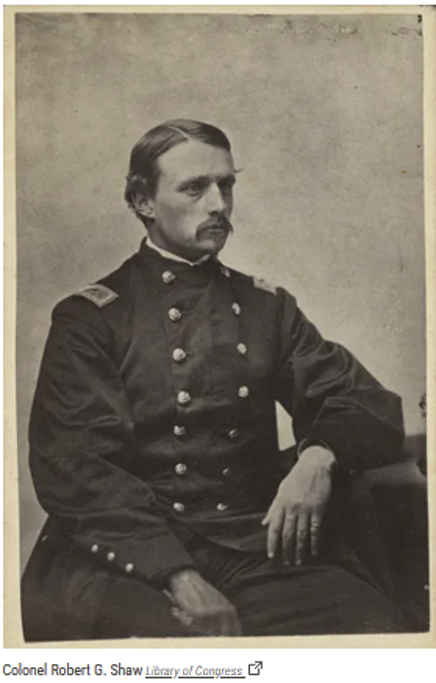
Subsequent assaults by the 6th Connecticut, 48th New York, 3rd New Hampshire, 9th Maine, 76th Pennsylvania, 7th New Hampshire, 100th New York, 62nd Ohio, and 67th Ohio pressed the hard fighting Confederate defenders to their limits, but failed to take the fort. The surviving Federal soldiers streamed back to their positions south of the fort late in the evening of July 18. Federal casualties reached 1,515, with the 54th Massachusetts losing 42% of its ranks in the attack. Brigadier General George Strong and three colonels, including the leader of the 54th Massachusetts, Col. Robert G. Shaw, were killed or mortally wounded in the attack. Light by comparison, Confederate losses numbered just 174 men.
Source: https://www.battlefields.org/learn/articles/fort-wagner
54th Massachusetts Colored Regiment
Regiment Formation
The 54th Massachusetts was one of the first United States military regiment comprised of African American soldiers in the Union during the Civil War. After President Abraham Lincoln’s issuance of the Emancipation Proclamation, states were officially allowed to create all Black regiments. Massachusetts was the first state to begin the formation of these newly authorized Black regiments. Massachusetts Governor John A. Andrew called for men to lead this experimental unit who were, “young men of military experience, of firm anti-slavery principles, ambitious, superior to a vulgar contempt for color, and have faith in the capacity of colored men for military service.” This call perhaps produced more active abolitionists for the 54th and her sister regiment the 55th than any other regiment in the North.
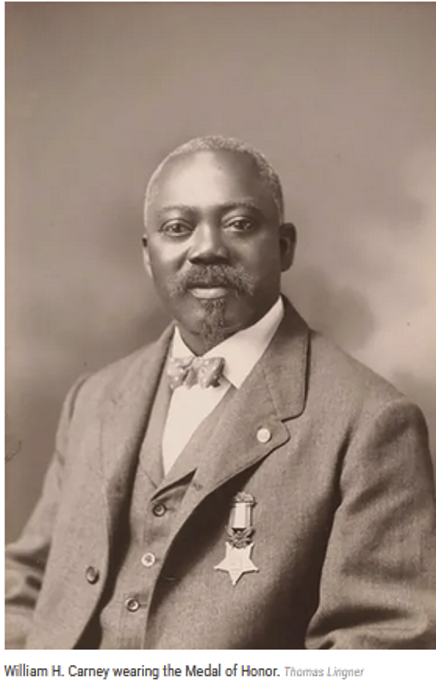
The formation of the 54th Massachusetts was closely watched by the public and politicians within the Union. Massachusetts governor John A. Andrew spearheaded the effort of the creation of this new unit. Many in the north had the perception that the war was a “white man’s war” and that freed African Americans should not serve in any fighting roles whatsoever. Many also believed that the men would lack discipline and would easily waiver in battle. In time, however, these misconceptions would drastically change. The man to lead the 54th was Robert Gould Shaw. Shaw was a member of the 2nd Massachusetts and had already seen combat and was previously wounded at the Battle of Antietam. In February of 1863, recruiting for the 54th began and Shaw was promoted to colonel of the regiment. By May of 1863, the regiment had filled to one thousand men and consisted of men from not only Massachusetts, but from New York, Pennsylvania, and other northern cities and states. Of those one thousand were two of Frederick Douglass’ sons Lewis and Charles Douglass, as well as the first African American recipient of the Medal of Honor William Carney. On May 28, 1863, the men were ready to depart on their journey. The 54th marched through Boston with a crowd of twenty thousand cheering them on to their departure. The 54th loaded onto the Demolay and ventured south.
Source: https://www.battlefields.org/learn/articles/54th-massachusetts-infantry-regiment

Early Engagements
The 54th Massachusetts arrived in South Carolina under the command of James Montgomery, an Ohio native that led the 2nd South Carolina Volunteers – a freedman’s regiment. Shaw and Montgomery led a raid on the small town of Darien, Georgia in which Montgomery instructed the 2nd Carolina and the 54th Massachusetts to loot the town and subsequently set fire to the town. Shaw opposed Montgomery but complied with Montgomery’s orders to avoid risking a court-martial.
Two months later, on July 16, 1863, the regiment’s first major engagement of the war took place. Located on James Island outside of Charleston, South Carolina, the Battle of Grimball’s Landing gave a chance for the regiment to prove themselves in battle. The 54th successfully stopped a Confederate advance meant for the 10th Connecticut that was retreating. Repeatedly, the 54th Massachusetts repelled Confederate advances until the 10th Connecticut could withdraw from the area. After the smoke settled, the 54th had amassed 43 casualties, while the Confederates were pushed back.
Fort Wagner
... Just two days later, on July 18, 1863, the 54th was in the vanguard of the assault on Fort Wagner, overlooking Charleston Harbor. The battle was the bloodiest battle that the 54th witnessed, with a total of 270 casualties out of the 600 men in the regiment during the battle. Colonel Robert Shaw was killed during the engagement, leaving Edward Hallowell in charge of the 54th. Union forces were unable to take Fort Wagner by frontal assault, however, the 54th Massachusetts was noted for their bravery and valor in battle. The 54th's actions displayed in battle paved the way for the Union to begin requisitioning more Black regiments to contribute in the war effort.
On May 23, 1900, Sergeant William Carney was awarded the Medal of Honor, being the first African American to receive the medal for his actions during the Battle of Fort Wagner. (Robert Blake was the first African American to physically receive the Medal of Honor as his was issued in 1864, Carney is the first African American to perform the action that earned him the Medal of Honor.) Carney was severely wounded while serving as color bearer after the previous color bearer fell in battle. He explained to the veterans of the 54th, “Boys, I did but my duty; the dear old flag never touched the ground.”
1864 - 1865 Actions
In February of 1864, the 54th fought at the Battle of Olustee in Florida. The 54th was responsible for covering the retreating Union troops fleeing to Jacksonville, Florida after an intense battle. The 54th, along with the 35th United States Colored Troops, repulsed the Confederate advance successfully.
The 54th Massachusetts fought up until mid-April 1865 at the Battle of Boykin’s Mill in South Carolina. The 54th engaged the highly outnumbered Confederate troops in a successful attack that left two men killed and thirteen wounded. One of the killed men was First Lieutenant E.L. Stevens, who was the last Union officer to be killed in the Civil War. Boykin’s Mill also is noted for being the last battle in South Carolina, and one of the final battles of the war. Following the war, the 54th Massachusetts was mustered out of service on August 20, 1865, in Mount Pleasant, South Carolina.
Legacy
The 54th Massachusetts defied the odds put up against them in a time of uncertainty. Becoming one of the first all-Black soldier regiments in the history of the United States, the 54th proved themselves in battle and showed the country that had discounted them from the start that they were formidable in combat. Despite scrutiny by the Union, the men of the 54th were accredited with turning the tide of war due to the influx of Black regiments that were mustered into service by President Abraham Lincoln.
Source for the above: https://www.battlefields.org/learn/articles/54th-massachusetts-infantry-regiment
Create Your Own Website With Webador