Missouri Compromise of 1820
Purpose / Overview
The Missouri Compromise of 1820 was a law that tried to address growing sectional tensions over the issue of slavery.
On one side sit the 11 “free states,” where slavery is illegal. On the other side sit the 11 “slave states,” where it is foundational to their economy and society. This balance, especially in the U.S. Senate where each state gets two votes, is the only thing preventing one side from legally dominating the other....
...Missouri... wants to join the “slave state” side....giving the slave states a permanent majority in the Senate and the power to block any law that might threaten their institution. This terrifying possibility sent a shock wave through the nation, revealing a deep, sectional divide that many had preferred to ignore.
The Missouri Compromise was the desperate, ingenious, and ultimately temporary legislative solution that pulled the nation back from the brink of collapse. It was more than a law; it was a high-stakes political bargain that drew a line in the sand—literally—across the American continent, dictating the future of freedom and slavery for decades to come
By passing the law, which President James Monroe signed, the U.S. Congress admitted Missouri to the Union as a state that allowed slavery, and Maine as a free state. It also banned slavery from the remaining Louisiana Purchase lands located north of the 36º 30’ parallel (the southern border of Missouri). The Missouri Compromise would remain in force for just over 30 years before it was repealed by the Kansas-Nebraska Act of 1854. In 1857, the Supreme Court ruled in the Dred Scott decision that the compromise was unconstitutional, setting the stage for the Civil War.
Effects of the Missouri Compromise:
Maintained Political Balance: The Missouri Compromise admitted Missouri to the Union as a slave state but simultaneously admitted Maine as a free state, preserving the delicate equilibrium between free and slave states in the United States Senate.
Drew a Line Across America: The Missouri Compromise established the 36°30′ parallel of latitude as the dividing line for all future states carved from the Louisiana Purchase; slavery was prohibited north of this line but permitted south of it.
Delayed the Civil War: The Missouri Compromise was a crucial, if flawed, legislative patch that successfully quieted the explosive issue of slavery's expansion for over 30 years, pushing the inevitable national reckoning further into the future.
Sources:
What is the Missouri Compromise? A 30-Second Summary
US Law Explained
https://uslawexplained.com/missouri_compromise#what_is_the_missouri_compromise_a_30-second_summary
Missouri Compromise
History.com Editors

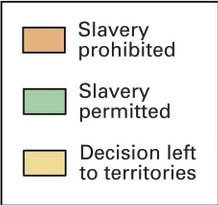
Source:
Extension of Slavery in the United States
Britannica.com
Key Components of the Missouri Compromise
Element 1: Missouri Enters as a Slave State
The admission of Missouri as a slave state was the catalyst for the entire crisis and the non-negotiable demand of the Southern states. For them, this was a matter of survival. Their economic system was built on enslaved labor, and they feared that a free-state majority in Congress could eventually vote to abolish slavery everywhere. They also argued on the grounds of States Rights, believing that the federal government had no authority to tell a new state whether it could or could not permit slavery. Allowing Missouri to enter with slavery was a victory for this principle and a confirmation that their “peculiar institution” was safe, for now.
Element 2: Maine Enters as a Free State
The admission of Maine was the stroke of political genius that made the compromise possible. It allowed the North to “give” the South Missouri without losing the all-important balance of power in the Senate. Without Maine's simultaneous admission, Northern congressmen would never have agreed to allow another slave state into the Union. This tit-for-tat approach—one for you, one for me—became a recurring theme in the antebellum period, highlighting how the nation was essentially functioning as two separate, competing entities under one government.
Element 3: The 36°30′ Parallel Line
This imaginary line drawn across the continent was the most consequential element of the compromise. It transformed the abstract debate over slavery's expansion into a concrete geographical rule. For the North, it was a major victory. A glance at the map showed that the vast majority of the Louisiana Purchase lay north of this line, seemingly securing a future of free states. For the South, it was a bitter pill to swallow, but one they accepted in exchange for Missouri and the protection of slavery in the Arkansas territory. However, this line implicitly accepted the premise that Congress had the authority to regulate slavery in the territories—a premise the South would later ferociously challenge, leading to the Compromise's eventual destruction.
Source:
The Anatomy of the Missouri Compromise: Key Components Explained
US Law Explained
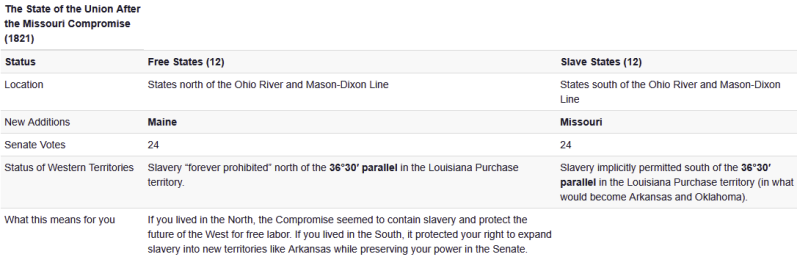
Illustrative Table - Missouri Compromise
Table Source:
US Law Explained
Create Your Own Website With Webador