Kansas - Nebraska Act of 1854
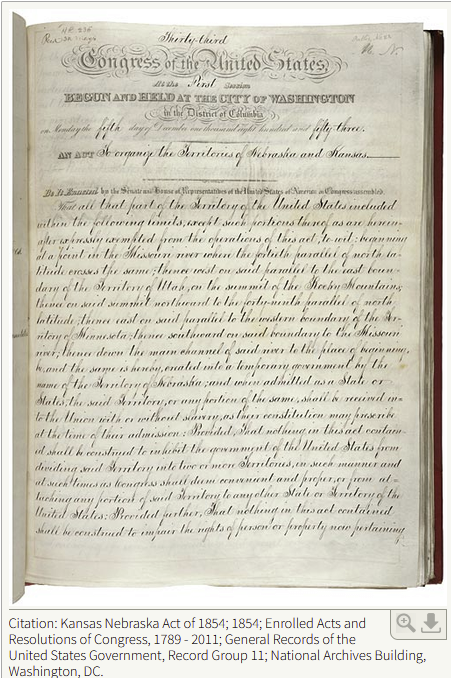
Overall Result of the Kansas - Nebraska Act
Officially titled "An Act to Organize the Territories of Nebraska and Kansas," this act repealed the Missouri Compromise (1820), which had outlawed slavery above the 36º30' latitude in the Louisiana territories, and reopened the national struggle over slavery in the western territories.
Source:
Kansas-Nebraska Act (1854)
National Archives/Milestone Documents
https://www.archives.gov/milestone-documents/kansas-nebraska-act
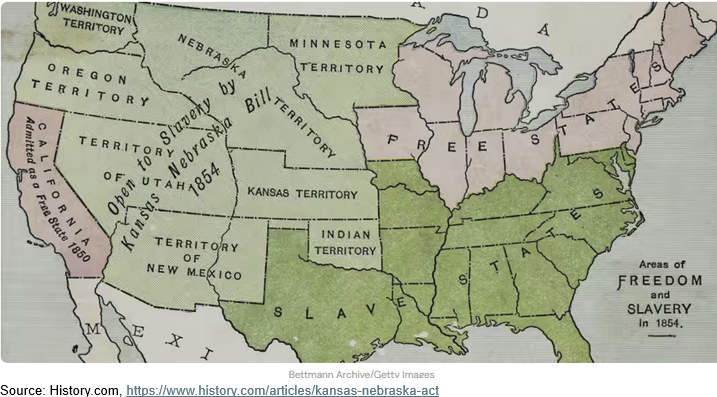
Kansas - Nebraska Act Summary
By the 1850s there were urgent demands to organize the western territories. Land acquired from Mexico in 1848, the California gold rush of 1849, and the relentless trend toward westward expansion pushed farmers, ranchers, and prospectors toward the Pacific. The Mississippi River had long served as a highway to north-south traffic, but western lands needed a river of steel, not of water—a transcontinental railroad to link the eastern states to the Pacific.
lllinois Senator Stephen Douglas, one of the railway’s chief promoters, wanted a northern route via Chicago, but that would take the rail lines through the unorganized Nebraska territory, which lay north of the 1820 Missouri Compromise line where slavery was prohibited (emphasis added). Others, particularly slaveholders and their allies, preferred a southern route, perhaps through the new state of Texas....
...To pass his “Nebraska bill,” Douglas needed a compromise....
On January 4, 1854, Douglas introduced a bill designed to tread middle ground. He proposed organizing the vast territory “with or without slavery, as their constitutions may prescribe.” Known as “popular sovereignty,” this policy contradicted the Missouri Compromise and left open the question of slavery (emphasis added), but that was not enough to satisfy a group of powerful southern senators.... [who] wanted to explicitly repeal the 1820 line. Douglas viewed the railroad as the “onward march of civilization,”. [Douglas agreed to the demands of the southern senators.]...
... [Douglas's agreement to repeal the 1820 Missouri Compromise line for slavery expansion in exchange for northern expansion of the transcontinental railroad meant that] the debate over the Nebraska bill was no longer a discussion of railway lines. It was all about slavery....
...[T]he Senate voted 37-14 to pass the Nebraska bill. It became law on May 30, 1854....
The Kansas-Nebraska Act repealed the Missouri Compromise, created two new territories (Nebraska and Kansas), and allowed for popular sovereignty. [The Act] also produced a violent uprising ... as pro-slavery and anti-slavery activists flooded into the territories to sway the vote. [The political created by passage of the Kansas-Nebraska Act led to] political turmoil, [including creation of] the Republican Party.
...[The bill touted] as a peaceful solution of national issues [actually became] a prelude to civil war.
Source:
The Kansas-Nebraska Act
United States Senate
https://www.senate.gov/artandhistory/history/minute/Kansas_Nebraska_Act.htm
See also:
Kansas-Nebraska Act
History.com Editors
Published October 29, 2009; updated December 09, 2025
https://www.history.com/articles/kansas-nebraska-act
Kansas - Nebraska Act (1854)
National Archives
https://www.archives.gov/milestone-documents/kansas-nebraska-act
Create Your Own Website With Webador