Dred Scott Case (1857) - Supreme Court Inflames Slavery Debate
Summary
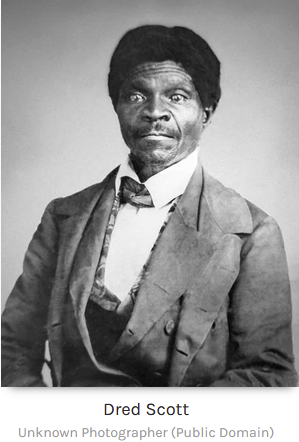
The case began as a simple freedom suit filed by the slave Dred Scott (circa 1799-1858) and his wife Harriet Scott (née Robinson, circa 1820-1876) against Irene Emerson, widow of Dr. John Emerson (their owners) arguing that, since Dr. Emerson had taken the Scotts (and their two daughters) into free states, where they had taken up residence, they were free. The suit was filed in April 1846 and dragged on for eleven years until it was heard by the US Supreme Court, which ruled 7-2 that the Scotts could not sue for their freedom because they were not citizens of the United States and were, therefore, not entitled to the rights and protections of US citizens. (World History Encyclopedia; https://www.worldhistory.org/Dred_Scott_Decision/)
Supreme Court Ruling
...[T]he U.S. Supreme Court [ruled] that enslaved people were not citizens of the United States and, therefore, could not expect any protection from the federal government or the courts....The decision also argued that the Missouri Compromise legislation — passed to balance the power between slave and non-slave states — was unconstitutional. In effect, this meant that Congress had no power to prevent the spread of slavery.... In addition, Chief Justice Roger Taney wrote [in his opinion] that the Fifth Amendment protected slave owner rights because enslaved workers were their legal property. (History.com; https://www.history.com/articles/dred-scott-case and National Archives; https://www.archives.gov/milestone-documents/dred-scott-v-sandford)
The decision, which was intended by the Supreme Court to put the issue of slavery in the United States to rest, only increased tensions between slave and free states, contributing to the outbreak of the Civil War. Today, it is regarded as the worst ruling in the history of the United States Supreme Court. (World History Encyclopedia; https://www.worldhistory.org/Dred_Scott_Decision/)
Dred Scott Decision: Impact on Civil War
The Dred Scott Decision outraged abolitionists, who saw the Supreme Court’s ruling as a way to stop debate about slavery in the territories. The divide between North and South over slavery grew and culminated in the secession of southern states from the Union and the creation of the Confederate States of America. The Emancipation Proclamation of September 22, 1862 freed enslaved people living in the Confederacy, but it would be another three years until Congress passed the 13th Amendment abolishing slavery in the United States. (National Archives; https://www.archives.gov/milestone-documents/dred-scott-v-sandford)
Dred Scott Freedom
By the time the U.S. Supreme Court handed down its Dred Scott decision, Irene had married her second husband, Calvin Chaffee, a U.S. congressman and abolitionist. Upset upon learning his wife still owned the most infamous slave of the time, he sold Scott and his family to Taylor Blow, the son of Peter Blow, Scott’s original owner.
Taylor freed Scott and his family on May 26, 1857. Scott found work as a porter in a St. Louis hotel, but didn’t live long as a free man. At about 59 years of age, Scott died from tuberculosis on September 17, 1858. (History.com; https://www.history.com/articles/dred-scott-case and National Archives; https://www.archives.gov/milestone-documents/dred-scott-v-sandford)
Sources:
Dred Scott Decision: Worst Supreme Court Ruling in US History
World History Encyclopedia
by Joshua J. Mark; published on 11 June 2025
https://www.worldhistory.org/Dred_Scott_Decision/
Dred Scott Case
History.com Editors
https://www.history.com/articles/dred-scott-case
Dred Scott v. Sandford (1857)
National Archives
Archives.gov
https://www.archives.gov/milestone-documents/dred-scott-v-sandford
In April 1846, Dred [Scott] and [his wife], Harriet filed separate lawsuits for freedom in the St. Louis Circuit Court against Irene Emerson based on two Missouri statutes. One statute allowed any person of any color to sue for wrongful enslavement. The other stated that any person taken to a free territory automatically became free and could not be re-enslaved upon returning to a slave state.
Neither Dred nor Harriet Scott could read or write and they needed both logistical and financial support to plead their case. They received it from their church, abolitionists and an unlikely source, the Blow family who had once owned them.
Since Dred and Harriet Scott had lived in Illinois and the Wisconsin Territory — both free domains — they hoped they had a persuasive case. When they went to trial on June 30, 1847, however, the court ruled against them on a technicality and the judge granted a retrial.
The Scotts went to trial again in January 1850 and won their freedom. Irene appealed the case to the Missouri Supreme Court which combined Dred and Harriet’s cases and reversed the lower court’s decision in 1852, making Dred Scott and his family enslaved again.
Dred Scott Decision: Impact on Civil War
The Dred Scott Decision outraged abolitionists, who saw the Supreme Court’s ruling as a way to stop debate about slavery in the territories. The divide between North and South over slavery grew and culminated in the secession of southern states from the Union and the creation of the Confederate States of America. The Emancipation Proclamation of September 22, 1862 freed enslaved people living in the Confederacy, but it would be another three years until Congress passed the 13th Amendment abolishing slavery in the United States. (National Archives; https://www.archives.gov/milestone-documents/dred-scott-v-sandford)

Story
Create Your Own Website With Webador