Compromise of 1850 - California Statehood
Issues Leading to the Compromise of 1850
- The US-Mexican War led the US to acquire the vast territories of New Mexico Utah and California….
- As population grew and the gold rush attracted more people to California, its Constitutional Convention met in 1849 to present the proposed constitution to Congress. The Convention outlawed slavery from its territory and petitioned to the U.S government to be admitted to the union as a free state.
- Accepting a new free state would affect the political equilibrium achieved in the 1820 Missouri Compromise. (Missouri Compromise of 1820)
- Texas claimed New Mexico and territory north of the Missouri Compromise where it wanted to expand slavery.
- Washington DC was the largest slave market in North America and Republicans wanted to change it.
- The North and South views on slavery were polarized. Southern leaders would never allow new free states into the Union,(Southern leaders) believed that there was a systematic force to destabilize slavery such as the north’s failed attempt to return fugitive slaves.
- The Louisiana Purchase in 1803 created new states. Allowing free states would be a call for secession from southern states and warfare. The alternative was to let the south secede from the Union or achieve some kind of compromise.
Source:
Compromise of 1850 – Definition and Summary/Issues of contention
Heritage Society
Source:
Extension of Slavery in the United States
Britannica.com
https://www.britannica.com/event/Missouri-Compromise
Compromise of 1850
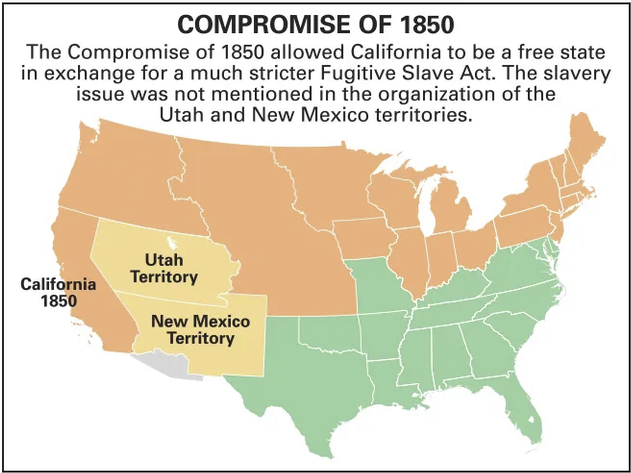
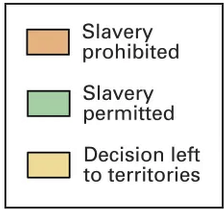
The Compromise of 1850 was made up of five bills that attempted to resolve disputes over slavery in new territories added to the United States in the wake of the Mexican-American War (1846-48). It admitted California as a free state, left Utah and New Mexico to decide for themselves whether to be a slave state or a free state, defined a new Texas-New Mexico boundary, and made it easier for slave owners to recover runways under the Fugitive Slave Act of 1850.
Following the U.S. Victory in the Mexican - American War, Mexico lost about one-third of its territory including nearly all of present-day California, Utah, Nevada, Arizona and New Mexico. A national dispute arose as to whether or not slavery would be permitted in the new Western territories.
The Compromise of 1850 was made up of five separate bills that made the following main points:
-
Permitted slavery in Washington, D.C., but outlawed the slave trade
-
Added California to the Union as a “free state”
-
Established Utah and New Mexico as territories that could decide via popular sovereignty if they would permit slavery
-
Defined new boundaries for the state of Texas following the Mexican-American War, removing its claims to parts of New Mexico but awarding the state $10 million in compensation
-
The Fugitive Slave Act of 1850 required citizens to assist in apprehending runaway slaves and denied enslaved people a right to trial by jury. (The Fugitive Slave Act of 1850 is summarized in this section at Fugitive Slave Act of 1850.)
Sources:
History.com Editors
History.com
https://www.history.com/articles/compromise-of-1850
Compromise of 1850 – Definition and Summary
Heritage Society
https://www.compromise-of-1850.org/summary/
Additional sources:
Compromise of 1850
Britannica.com
https://www.britannica.com/event/Compromise-of-1850
Create Your Own Website With Webador